Our methods and solutions aim to improve high-quality access to scientific information
Open Access
We strive to ensure our platforms and tools are open access, both for data consultation and downloading.
We maintain data dissemination agreements with a range of trusted sources, enabling us to generate and publish high-quality scientometric indicators. To support in-depth analysis and benchmarking across multiple levels, we also develop advanced visualizations. For this purpose, we offer SCImago Graphica, our open-access tool designed to create powerful, high-level data visualizations.
We have a deep understanding of university research environments, the processes that foster or hinder research, the mechanisms for achieving quality and the strategies for transforming organizational cultures within universities. Our experience as educators and university leaders enables us to design effective, current and relevant programs.
Global Data
We understand that meaningful analysis requires global, standardized and comparable data.
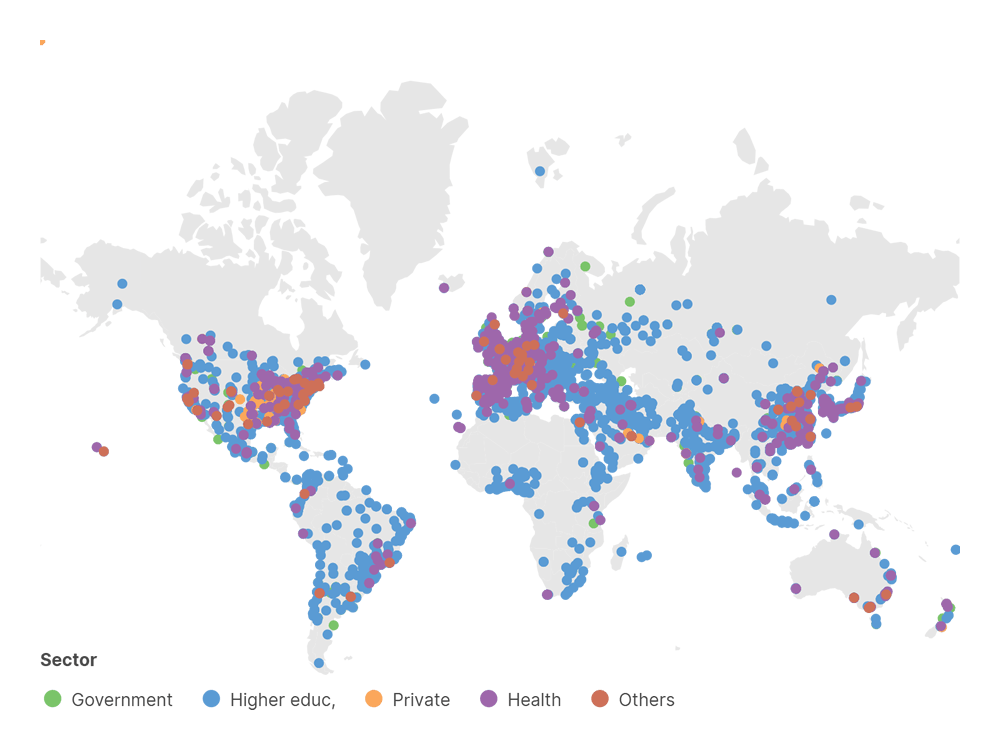
To analyze scientific output, we use the Scopus database, which was chosen for its volume, coverage and diversity of document types, as well as its extensive citation universe being the database with the highest number of citable documents.
Our innovation data comes from PATSTAT, which contains over 90 million bibliographic and legal patent records from more than 100 industrialized and developing countries. It serves as a unique foundation for conducting sophisticated analyses of bibliographic and legal status data.
We collect detailed information on the impact that scientific publications and patents generate on social media, thanks to data from PlumX, which enables us to analyze mentions on platforms such as X, Facebook, blogs, news and comments (including Reddit, Slideshare, Vimeo and YouTube).
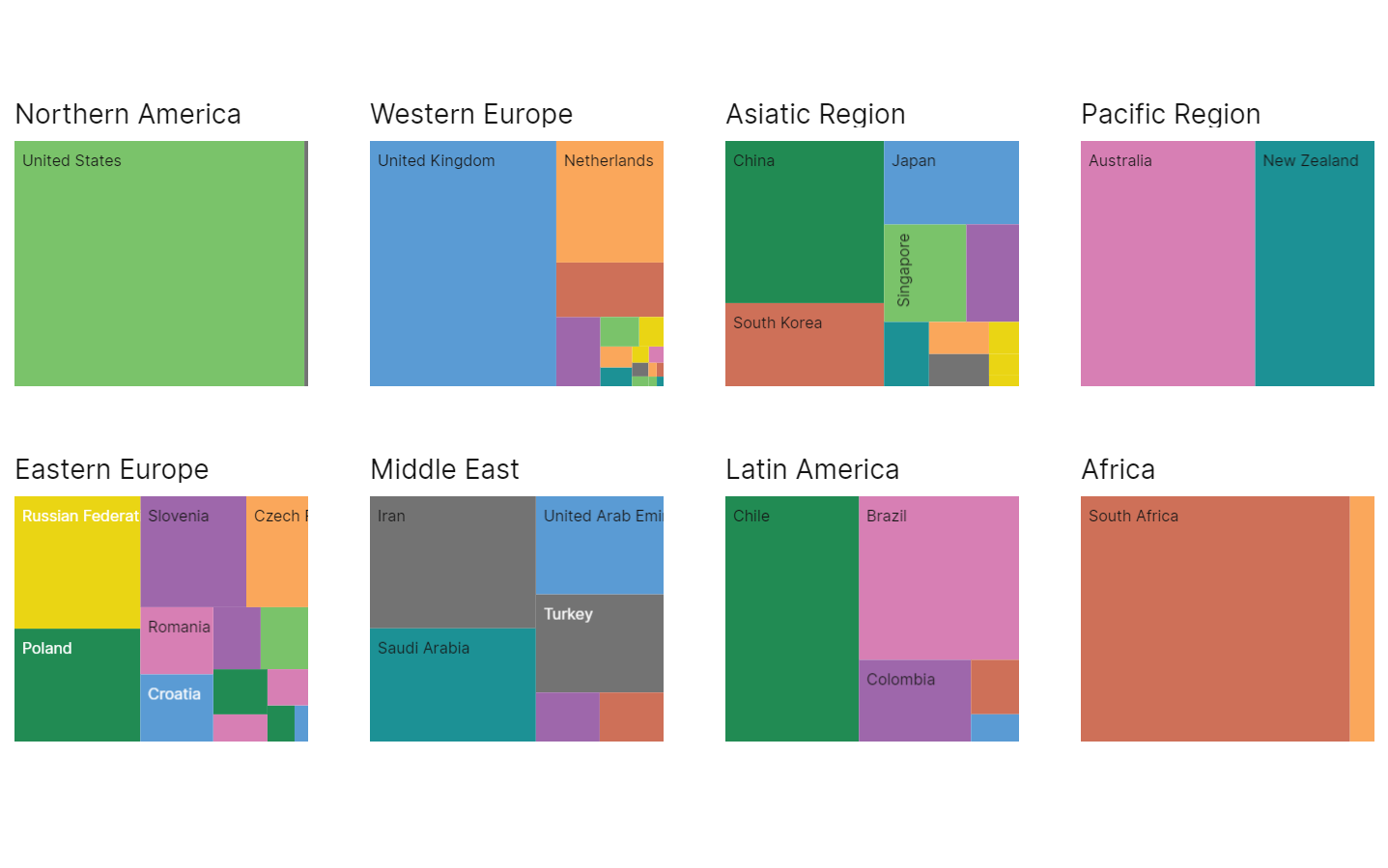
Coverage of these sources helps us to deliver a global and comparative perspective in our indicators, presented through accessible, free and regularly updated information systems.
Scientific validity
All the indicators we use for ranking generation have been previously validated by the scientific community and supported by publications in high-impact journals.
Aguillo, I.F., Bar-Ilan, J., Levene, M. et al. Comparing university rankings. Scientometrics 85, 243–256 (2010). https://doi.org/10.1007/s11192-010-0190-z
Arencibia-Jorge, R., Vega-Almeida, R. L., Chinchilla-Rodríguez, Z., Corera-Álvarez, E., Moya-Anegón, F. Patrones de especialización de la investigación nacional sobre Salud. Revista Cubana de Salud Pública 38, 5 (2012). https://doi.org/10.1590/s0864-34662012000500007
Bornmann, L., De Moya Anegón, F., Leydesdorff, L. (2012) The new Excellence Indicator in the World Report of the SCImago Institutions Rankings 2011. Journal of Informetrics, 6 (2), pp. 333-335. https://doi.org/10.1016/j.joi.2011.11.006
Bornmann, L., & Moya Anegón, F. (2014a). What proportion of excellent papers makes an institution one of the best worldwide? Specifying thresholds for the interpretation of the results of the SCImago Institutions Ranking and the Leiden Ranking. Journal of the Association for Information Science and Technology, 65 (4), 732-736. https://doi.org/10.1002/asi.23047
Bornmann, L., Stefaner, M., de Moya Anegón, F. and Mutz, R. (2014), “Ranking and mapping of universities and research-focused institutions worldwide based on highly-cited papers: A visualisation of results from multi-level models“, Online Information Review, Vol. 38 No. 1, pp. 43-58. https://doi.org/10.1108/OIR-12-2012-0214
Chinchilla-Rodríguez, Z., Vargas-Quesada, B., Hassan-Montero, Y., González-Molina, A., & Moya-Anegóna, F. (2010). New Approach to the Visualization of International Scientific Collaboration. Information Visualization, 9(4), 277–287. https://doi.org/10.1057/ivs.2009.31
Chinchilla-Rodríguez, Z., Benavent-Pérez, M., de Moya-Anegón, F. and Miguel, S. (2012), International Collaboration in Medical Research in Latin America and the Caribbean (2003–2007). J Am Soc Inf Sci Tec, 63: 2223-2238. https://doi.org/10.1002/asi.22669
Chinchilla-Rodríguez, Z., Zacca-González, G., Vargas-Quesada, B. et al. Benchmarking scientific performance by decomposing leadership of Cuban and Latin American institutions in Public Health. Scientometrics 106, 1239–1264 (2016). https://doi.org/10.1007/s11192-015-1831-z
González-Pereira, B., Guerrero-Bote,V., Moya-Anegón, F. (2010). A new approach to the metric of journal’s scientific prestige: The SJR indicator. Journal of Informetrics, 4(3), pp. 379–391. https://doi.org/10.1016/j.joi.2010.03.002
Guerrero-Bote, V.P., Moya-Anegón, F. (2012) A further step forward in measuring journals’ scientific prestige: The SJR2 indicator. Journal of Informetrics, 6 (4), pp. 674-688. https://doi.org/10.1016/j.joi.2012.07.001
Guerrero Bote, V.P., Olmeda-Gómez, C. and de Moya-Anegón, F. (2013), Quantifying the benefits of international scientific collaboration. J Am Soc Inf Sci Tec, 64: 392-404. https://doi.org/10.1002/asi.22754
Lancho-Barrantes, B.S., Guerrero-Bote, V.P. & de Moya-Anegón, F. Citation increments between collaborating countries. Scientometrics 94, 817–831 (2013). https://doi.org/10.1007/s11192-012-0797-3
Lancho Barrantes, B.S., Guerrero Bote, V.P., Rodríguez, Z.C. and de Moya Anegón, F. (2012), Citation flows in the zones of influence of scientific collaborations. J. Am. Soc. Inf. Sci., 63: 481-489. https://doi.org/10.1002/asi.21682
López-Illescas, C., de Moya-Anegón, F. & Moed, H.F. A ranking of universities should account for differences in their disciplinary specialization. Scientometrics 88, 563–574 (2011). https://doi.org/10.1007/s11192-011-0398-6
Miguel, S., Chinchilla-Rodriguez, Z. and de Moya-Anegón, F. (2011), Open access and Scopus: A new approach to scientific visibility from the standpoint of access. J. Am. Soc. Inf. Sci., 62: 1130-1145. https://doi.org/10.1002/asi.21532
Moya-Anegón, F., Chinchilla-Rodríguez, Z., Vargas-Quesada, B. et al. Coverage analysis of Scopus: A journal metric approach. Scientometrics 73, 53–78 (2007). https://doi.org/10.1007/s11192-007-1681-4
Moed, H.F., Moya-Anegón, F., López-Illescas, C., Visser, M. (2011). Is concentration of university research associated with better research performance? Journal of Informetrics. 5 (4) 649-658. https://doi.org/10.1016/j.joi.2011.06.003
Moya-Anegón, F. (2012). Liderazgo y excelencia de la ciencia española. Profesional De La Información, 21(2), 125–128. https://doi.org/10.3145/epi.2012.mar.01
Moya-Anegón, F., Guerrero-Bote, V.P., Bornmann, L. et al. The research guarantors of scientific papers and the output counting: a promising new approach. Scientometrics 97, 421–434 (2013). https://doi.org/10.1007/s11192-013-1046-0
Moya-Anegón, F. (dir.), Chinchilla-Rodríguez, Z. (coord.), Corera-Álvarez, E., González-Molina, A., Vargas-Quesada, B. (2013) Principales Indicadores Bibliométricos de la Actividad Científica Española: 2010. Madrid: Fundación Española para la Ciencia y la Tecnología. https://www.fecyt.es/es/system/files/publications/attachments/2014/11/indicadoresbibliometricos_2010.pdf
Moya-Anegón, F. (dir.), Chinchilla-Rodríguez, Z. (coord.), Corera-Álvarez, E., González-Molina, A., Vargas-Quesada, B. (2013) Excelencia y liderazgo de la producción científica española 2003-2010. Madrid: Fundación Española para la Ciencia y la Tecnología.
Moya-Anegón, F., Chinchilla-Rodríguez, Z. Impacto tecnológico de la producción universitaria iberoamericana. En: La transferencia de la I+D, la innovación y el emprendimiento en las universidades. Educación Superior en Iberoamérica. Informe 2015. Santiago de Chile: Centro Interuniversitario de Desarrollo, 2015, p. 83-94. http://hdl.handle.net/10261/115266
OECD and SCImago Research Group (CSIC) (2015), Compendium of Bibliometric Science Indicators 2014. https://www.oecd.org/sti/inno/scientometrics.htm
Romo-Fernández, L.M., Lopez-Pujalte, C., Guerrero Bote, V.P., Moya-Anegon, F. (2011). Analysis of Europe’s scientific production on renewable energies. Renewable Energy, 36 (9), pp. 2529-2537. https://doi.org/10.1016/j.renene.2011.02.001
Tibaná-Herrera, G., Fernández-Bajón, M.-T., & De-Moya-Anegón, F. (2018). Output, collaboration and impact of e-learning research: Bibliometric analysis and visualizations at the country and institutional level (Scopus 2003-2016). Profesional De La Información, 27(5), 1082–1096. https://doi.org/10.3145/epi.2018.sep.12